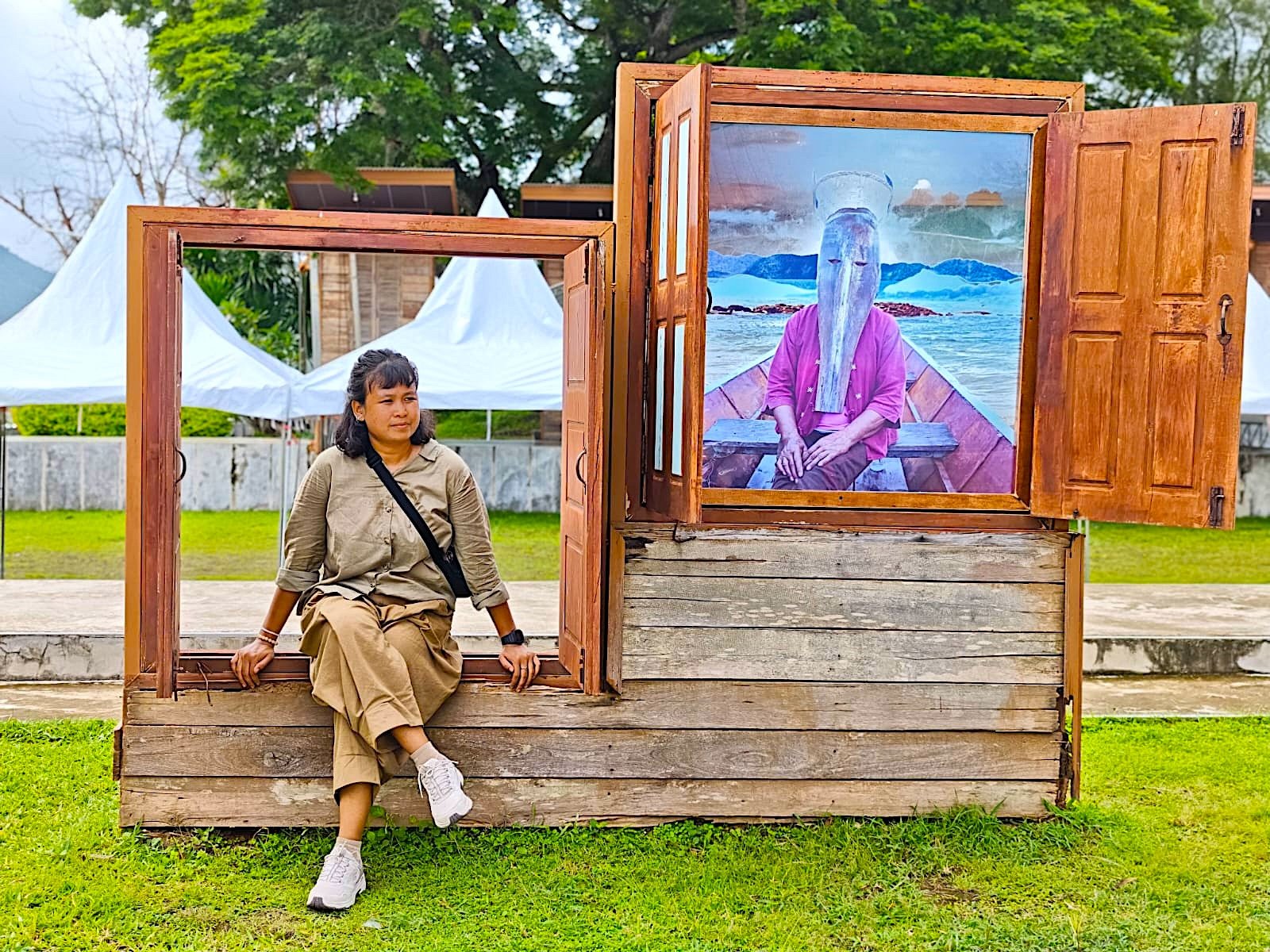
Sarah Ndele
Kinshasa, Democratic Republic of the Congo
Oracle Woman
Acrylic on canvas, 80 × 60 cm.


Sarah Ndele
Sarah Ndele is a visual artist based in Kinshasa whose practice spans painting, sculpture, and performance. Her work is rooted in what she describes as “keeping the root”, a commitment to staying connected to histories that are often forgotten, particularly those of women.
Drawing inspiration from figures such as Harriet Tubman, Rosa Parks, Kimpa Vita, and Joan of Arc, she does not replicate the past but reimagines it, bringing these histories into dialogue with the present. For Sarah, art is not only a visual language but a way of restoring erased narratives, and reactivating strength across generations.
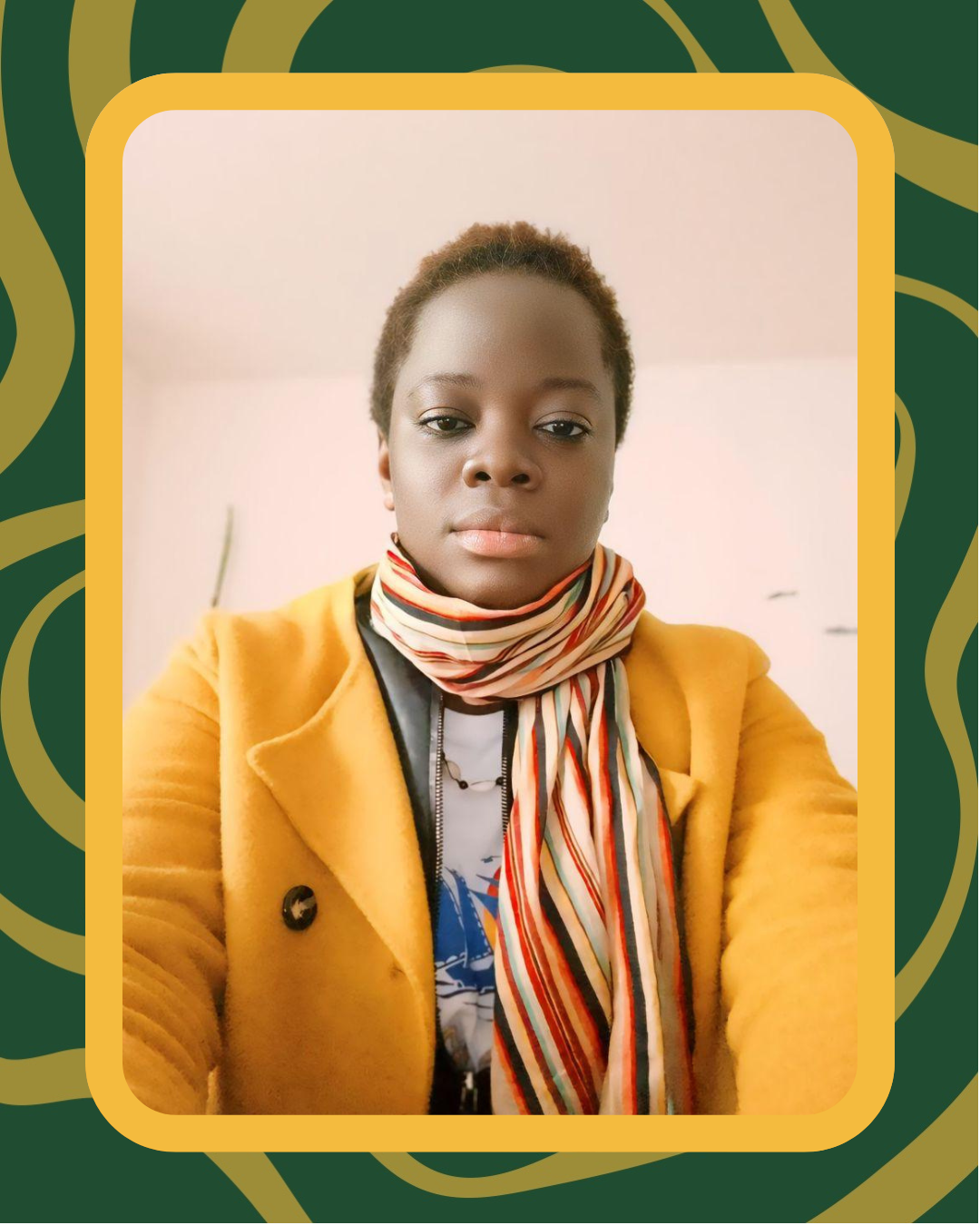
“Art is a way to heal, to tell stories, and to speak out.
It is a way to remember the women who came before us and to carry their strength forward.”
Sarah

Oracle Woman
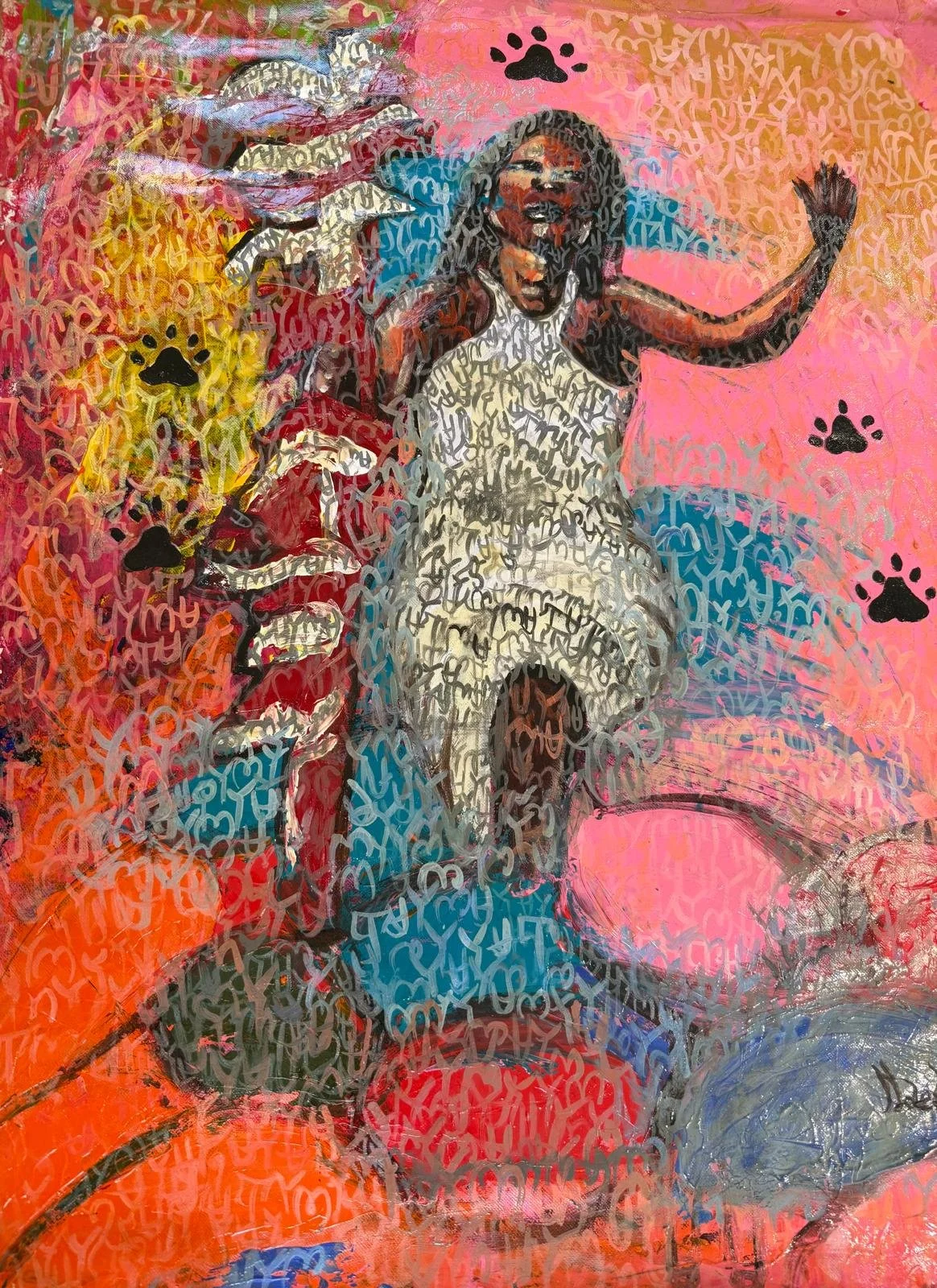
Oracle Woman presents a figure who is both guardian and witness. She stands in motion—alive with colour, layered with handwritten marks, surrounded by symbols that resist fixed interpretation.
Created in response to the violence affecting the Democratic Republic of the Congo, the painting refuses to portray women as victims. Instead, the central figure embodies a different kind of power: protective, attentive, and enduring.
The staff she holds signals leadership and authority. The surrounding forms—sometimes read as wings or birds—suggest spiritual strength rather than escape. Across the surface, handwritten gestures accumulate like memory itself: fragmented, repeated, insistent.
Small but striking, the cat paw prints scattered across the canvas evoke quiet presence—women who move carefully, protect silently, and leave traces that cannot be erased.
The palette – warm, luminous, layered – speaks of tenderness as strength. Here, softness is not fragility but a form of resistance.

Themes in Sarah’s work
Distance
Kinshasa stands apart from the frontlines of war, yet is deeply shaped by its consequences—politically, emotionally, and socially.
The Body as Archive
In the absence of stable systems of memory and justice, the body carries history—violence, care, endurance, and survival.
Resilience as Condition
Resilience is not an abstract ideal but a lived necessity—embedded in daily life.
Improvised Living
The city is built through adaptation rather than stability. Life is continuously negotiated.
Silence and Presence
Global silence around the conflict contrasts with the intensity of lived experience on the ground.
Kinshasa:
A City of Distance and Intensity
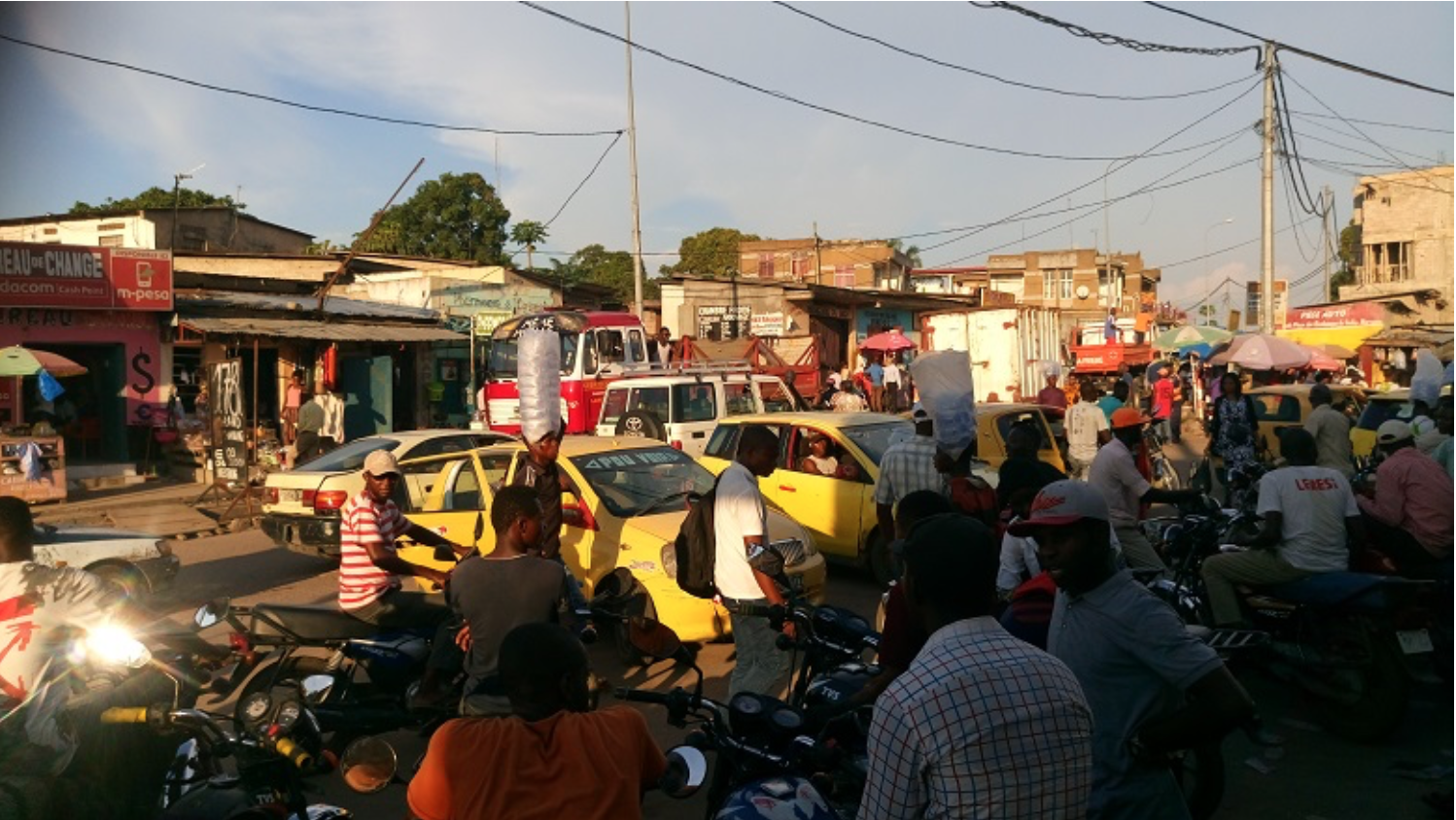
Kinshasa, one of Africa’s largest megacities, is a place of immense cultural energy and profound contradiction. While much of the violence in the Democratic Republic of the Congo unfolds in the eastern regions, Kinshasa remains the political and symbolic centre—where decisions are made, narratives are shaped, and survivors often arrive seeking recognition and justice.
The city absorbs the impact of conflict through displacement and migration, economic instability, and the often-invisible aftermath of violence. These pressures are not always visible, yet they shape the rhythms of daily life.
Like many megacities, Kinshasa faces significant structural challenges. With a population approaching 15 million, it is marked by chronic congestion, widespread poverty, and unreliable infrastructure, alongside an increasing vulnerability to floods, droughts, and other climate shocks.
Yet, within this complexity, everyday life persists. Movement, sound, improvisation, and resilience define the urban experience. Creativity does not disappear in times of crisis—it adapts, persists, and transforms.
A Prolonged Crisis
The Democratic Republic of the Congo remains at the centre of one of the world’s most complex humanitarian crises. Millions live under conditions shaped by armed conflict, displacement, and environmental shocks. In the eastern provinces, armed groups compete for control of mineral-rich territories, driving cycles of violence and instability. Women and girls are disproportionately affected, often subjected to gender-based violence used as a tactic of war.
At the same time, climate-related disasters—flooding, food insecurity, and epidemics—intensify already fragile conditions. For many, daily life is defined by uncertainty, yet sustained by resilience and community solidarity.

Explore other cities
-
Kinshasa
Democratic Republic of the Congo
-
Karthoum
Sudan
-
Caracas
Venezuela
-
Zhmerynca
Ukraine
-
Ahwaz
Iran
-
Damascus
Syria