Baque Luar: Sound and sisterhood
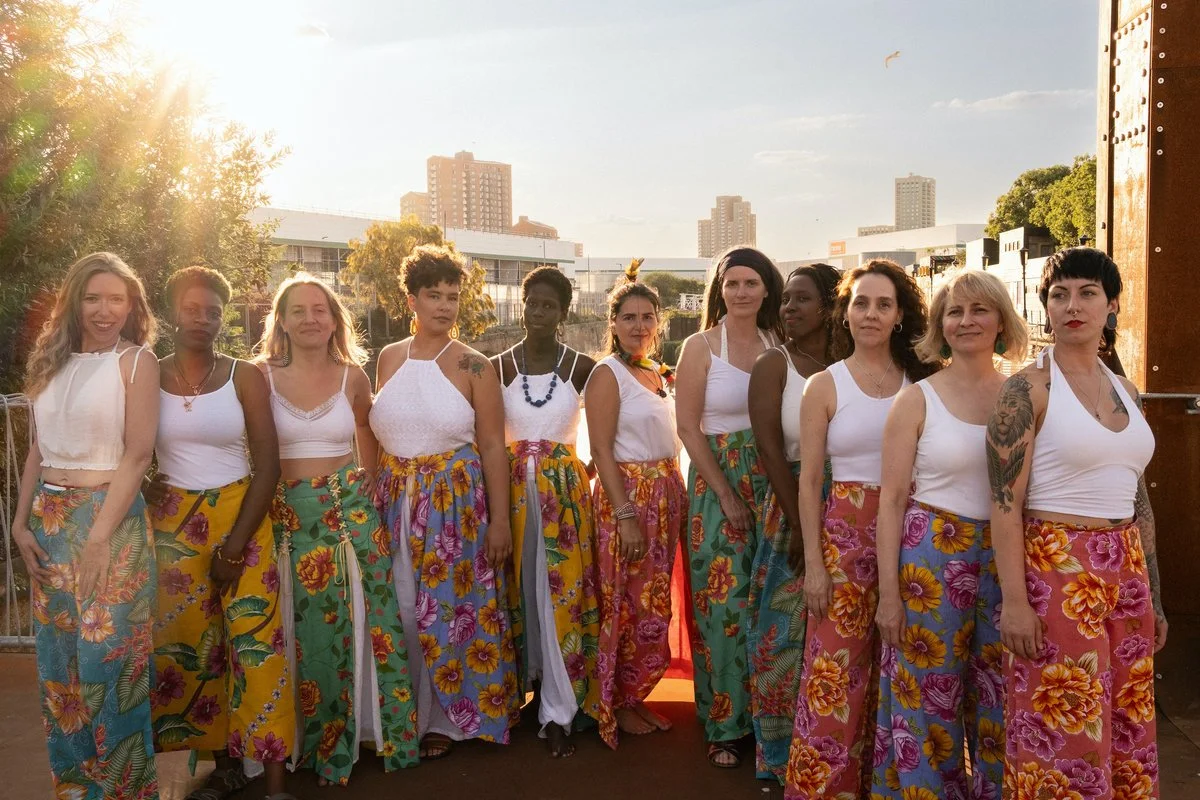
In a moment where music becomes ritual and rhythm transforms into resistance, Baque Luar - “moonlit beats” - emerges as a force of nature. This London‑based sisterhood of female and non‑binary vocalists and percussionists channels the heartbeat of Brazilian and Afro‑Brazilian roots music, weaving ancestral drum patterns with raw, unshakable harmonies. To celebrate their recent triumph in APE’s eco‑anthem music competition with their spellbinding track The Earth is Calling, Yasmin Dahnoun joins co‑founder Lizzie Ogle and vocalist Joy Dilá in conversation, exploring how their sound is at once spiritual, political, and profoundly empowering.
The Earth is Calling is now available on all streaming platforms! Please do listen, share, and buy. All royalties will be split between artistist project Earth and the artists themselves to continue supporting them beyond the competition!
INTERVIEW
Yasmin Dahnoun: I'd love to hear what inspired The Earth is Calling, one of the winning tracks of Artist Project Earth’s eco-anthem competition.
Lizzie Ogle: The song had been with me for years, since Baque Luar performed and camped at Shambala festival. I remember this melodic phrase looping in my head, “and the flowers bloom beneath our feet.”
Songs often arrive in that way – a kind of tapping on the shoulder, asking to be noticed. For a long time, I dismissed this one because it felt really simple. But I brought it to Baque Luar in rehearsal, and the group were up for it.
The collective process of arranging and performing the song enabled it to grow and flourish. That’s one of the powers of supporting each other’s creativity, helping root it so it can develop into something real.
What’s interesting is that it’s our first song completely written in English, so it’s a meeting of the maracatu rhythm with the culture of these lands, the British Isles, in a new way for us.
Yasmin: We can hear that in the song. So, can we talk some more about Baque Luar’s musical roots and inspirations?
Lizzie: Our foundation is Maracatu, an Afro-Brazilian drumming tradition from the Northeast of Brazil, especially Recife, Pernambuco. It's both musical and spiritual, with deep connections to Candomblé – an Afro-Brazilian cosmology honouring nature, the ancestors and our connections with divinity.
We learn and practice Maracatu not just rhythmically, but as a way of remembering how to connect spiritually, ancestrally, and in alignment with the natural world. We work closely with Leão Coroado, a Maracatu nation in Recife. I met them in 2012, which began a long journey of learning and collaboration.
Joy Dilá: It’s hard to translate the depth of these traditions. But creating space to explore them, to connect spiritually through rhythm, is beautiful. Maracatu is a living cultural library. Each one of us connects to it in our way, but always with deep-rootedness. It’s a connection woven beneath the surface; under the grass, through the soil.
I remember my first moment playing a bumbo (big bass drum) in Baque Luar. I struck it gently, and Lizzie told me to “make a bigger sound”. I then noticed how I had hesitated. Then she said something that’s stayed with me.
Women and people with wombs are rarely encouraged to take up space with sound - we're often steered towards instruments that require delicacy and control, not boldness.
In Baque Luar, we work towards reclaiming this space for ourselves and others to make unapologetic noise.
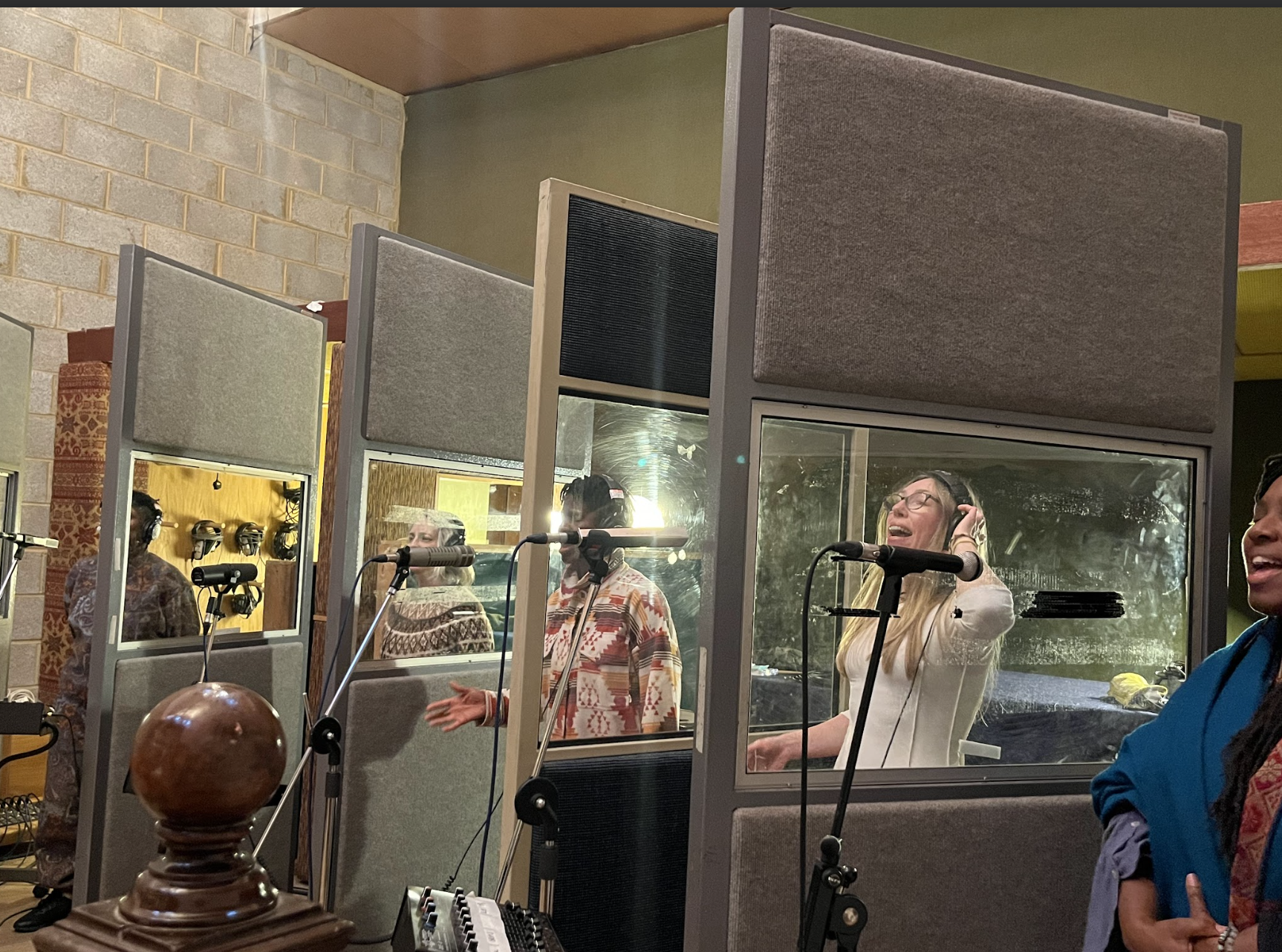
Baque Luar recording ‘The Earth is Calling’ at Fish Factory Studios, London
Yasmin: How would you describe your ancestral connection to the music, and how it relates to its healing and collective dimensions?
Lizzie: Baque Luar is a mosaic of lineages: British, Brazilian, Afro-Brazilian, Jamaican, Iraqi, Jewish, Irish, Beninese, Indigenous…and within those identity labels, there are a multitude of sub-categories that we could use to describe ourselves.
Each person holds a piece of our global, ancestral story; we're navigating a fragmented world, and for whatever reason, we’ve all been drawn to this same family of rhythmic practices. I believe that these rhythms, which are much older and wiser than we are, can guide us through our senses and emotions, towards healing some of these overarching cultural wounds: colonialism, patriarchy, intergenerational trauma..
Personally, I carry coloniser, colonised and historically oppressed ancestral lineages within me. That tension lives in many of us. Baque Luar offers a space to meet those parts of ourselves with creativity, and that’s healing.
In a world that often silences creativity, this group is medicine. It asks: What do you have to say? What do you need to sing?
Joy: My religion is a big part of how I experience the world. Growing up, there was no line between personal and spiritual life in the terreiro. And music is always there. It holds a sacred space in my life. It's a place of connection with others, with spirit.
I grew up singing for my ancestors whilst cooking for them, responding to the drums whilst doing my chores, praising nature and the Orixás all the time. It's all part of how we move in the world: singing, harmonising, drumming, dancing and going through life with rhythm, and in Baque Luar.
I often learn how other indigenous cultures around the world organise in a similar way. There’s always a song that can connect you to someone new, where despite the differences, somehow you're both coming from a similar place.
For me, Baque Luar is also a bridge back to Brazil when I am away. The first song in the album is about that. Mixing up that longing for home with the colours available in this city, and what emerges is something we find both new and ancient.
Baque Luar isn’t a “project”; it’s a response to something deep and necessary. And we try to draw guidance from our foremothers and how they’ve been holding these cultural practices alive. One of the elders we receive inspiration from is Lia de Itamaracá, a guardian of ciranda, a circular dance rooted in seaside communities in the Northeast of Brasil.
However, back home [in Brazil], it’s often the elders, the very old ones, who are still doing the heavy lifting, travelling, working, carrying, preserving these cultures every single day.
Yasmin: Drumming has long been associated with male dominance and shaped by patriarchal norms. How are you challenging the patriarchy through your relationship to music?
Lizzie: There have been studies about children being socialised by their gender in terms of which instruments they’re encouraged to learn and how they should play them. Though I hope this is changing, girls are often subtly directed towards classical traditions which actively inhibit musical freedom and improvisation skills, and encourage perfectionism. Perfectionism = trauma!
This is part of a patriarchal legacy that restricts how we express ourselves. One of our intentions with Baque Luar is to unlearn that, to create a space where feminine creativity is safe again.
Improvisation is essential, not just for music but for life. It demands presence, adaptability, embodiment and aliveness, and these skills are vital for the challenges we’re facing.
Joy: We are very inspired by Maracatu, which is a culture passed on through generations. It can be very gendered. Some of this gender stuff is rooted in spiritual tradition, but some of it comes with patriarchal noise.
We are seeing a lot of change in the Maracatu traditional communities, and we learn with them what is sacred and what deserves change. Leão Coroado nation, for example, is one of the oldest Maracatu Nations active today, and it is completely led and held by women in the forefront, and we are strongly connected to them.
Also, it's not enough simply not to be sexist – we need to be actively anti-patriarchy, collectively. And one of the ways we express that is by creating and embodying alternative ways of being and making music, and challenging this model that’s long been shaped by patriarchal structures, especially within the world of percussion.
As a non-binary person, I feel empowered when I can honour my womb and explore what that means for me, without needing to justify myself as a woman, or prove that I’ve learned something about womanhood.]
Yasmin: Thanks for these thoughts and deeper reflections. To close the interview, I’d love to know what your hopes and dreams are moving forward for Baque Luar? Anything existing in the pipeline?
Joy: We often invite people to play with us in workshops where we focus on rhythmic creativity, voice-work, improvisation and self-expression. Those spaces feel vibrant, alive, and necessary.
Lizzie: Right now, my dream is to return to more inward ways of being together. Recording has been beautiful because it allows us to create and share without constantly performing or preparing for gigs. Recording drums well requires proper space and resources – it’s not something you can DIY in a bedroom. So I'm grateful we've had that opportunity.
I’d love for us to return to Brazil, to deepen our learning and grow those cultural exchanges. Maybe this moment is about refilling our cups, re-rooting and slowing down a bit.
Your Support
Wherever we live, the impacts of climate change, habitat destruction, and pollution are undeniable, but so is our collective power to respond. Artist Project Earth partners with musicians worldwide to raise funds for communities on the frontlines of the climate emergency and to back projects that are helping restore our fragile planet. We also champion artists creating transformative music and visual art.
Join us in making a difference — donate today and help turn music into action.